London’s Free Museums by Tube: A Line-by-Line Guide
London is one of the only major capital cities where you can spend an entire day in world-class museums and never pay for entry. Better still, almost every one of them sits a short walk from a Tube station.
This guide organises eight of London’s best free museums by Underground access — the line, the station, the walking time, and what else is worth doing nearby. Whether you’re building a full museum day or slotting a stop into a wider Tube itinerary, this is the practical version of the guide.
A quick note on timing: museums are busiest on Saturday mornings and school-holiday weekdays. Visit on a weekday outside July–August and you’ll often have the galleries to yourself. Always check a museum’s website before you go — some temporary exhibitions and the Science Museum’s IMAX screenings require a paid ticket even though general admission is free.
London for First-Time Visitors: 3-Day Itinerary
1. British Museum
🚇 Tube: Tottenham Court Road — Central line · Northern line
The British Museum is one of the most visited museums on earth, and it earns that reputation. Founded in 1753, its collection spans two million years of human history, from Egyptian mummies and the Rosetta Stone to the Sutton Hoo helmet and the Lewis Chessmen. Budget at least three hours — it’s easy to lose a whole day here.
The walk from Tottenham Court Road is about eight minutes along New Oxford Street, flat and straightforward. Coming from the east on the Central line, Holborn (Central and Piccadilly lines) gives a slightly more scenic walk through Bloomsbury’s backstreets.
After your visit: Tottenham Court Road opens onto Soho and Fitzrovia, both excellent for lunch or an afternoon coffee, and the surrounding streets are the heart of London’s independent guitar and music shops.
[INTERNAL LINK: “Central line” → Central Line Guide (pillar post)] [INTERNAL LINK: “Holborn” or “Piccadilly line” → Piccadilly Line Guide] [INTERNAL LINK: “Soho” → any Soho/West End station spotlight, once published]
2. National Gallery
🚇 Tube: Charing Cross — Bakerloo line · Northern line
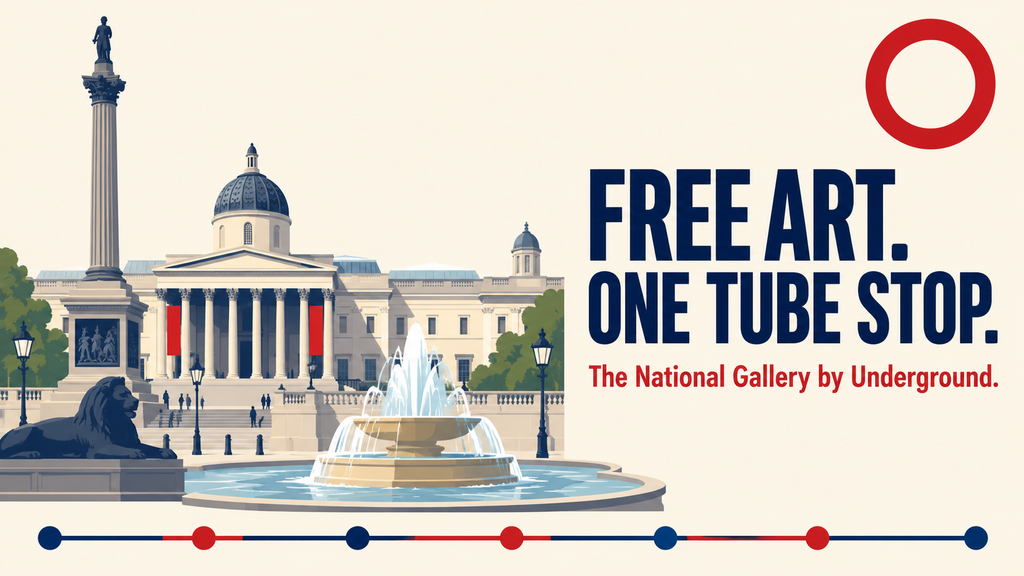
The National Gallery sits directly on Trafalgar Square, one of the few museums in London where the approach is almost as impressive as the building. Over 2,300 paintings dating from the mid-13th century to 1900 hang here — Van Gogh’s Sunflowers, Turner’s The Fighting Temeraire, da Vinci’s Virgin of the Rocks. Allow a focused two hours, or a leisurely afternoon.
Charing Cross station exits onto the Strand, a few minutes from the square. Leicester Square (Northern and Piccadilly lines) is an equally easy approach if you’re already on the Northern line.
After your visit: Walk down Whitehall to Parliament and Westminster (20 minutes on foot, or one stop on the Northern line to Westminster), or head east along the Strand toward Covent Garden.
3. Natural History Museum
🚇 Tube: South Kensington — Circle line · District line · Piccadilly line
One of London’s finest buildings as well as one of its finest museums — the Romanesque terracotta facade alone is worth the trip. Inside, the Great Hall with its suspended blue whale skeleton is genuinely breathtaking. The dinosaur galleries, the Vault (precious stones and meteorites), and the seasonal Wildlife Photographer of the Year exhibition are highlights.
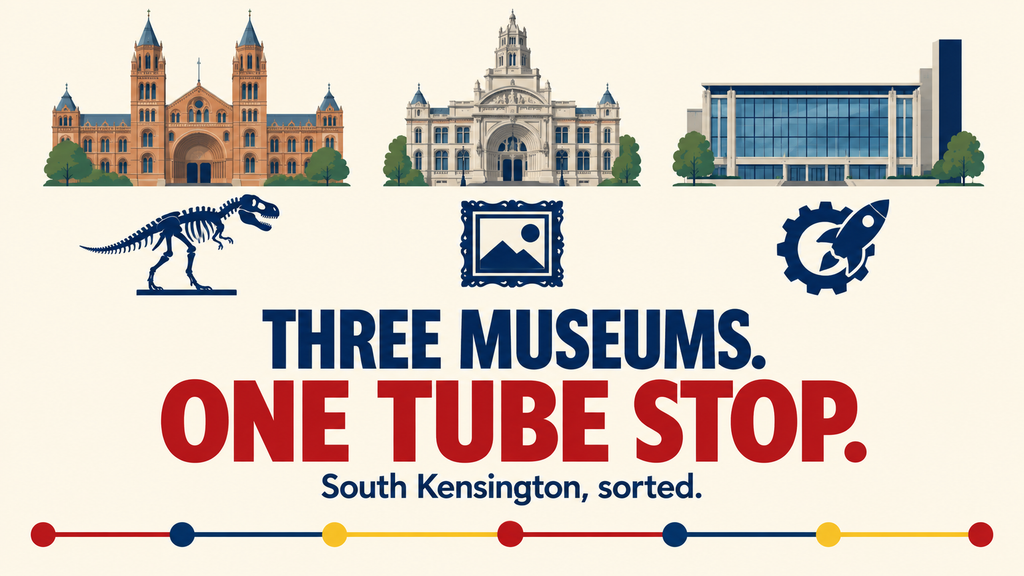
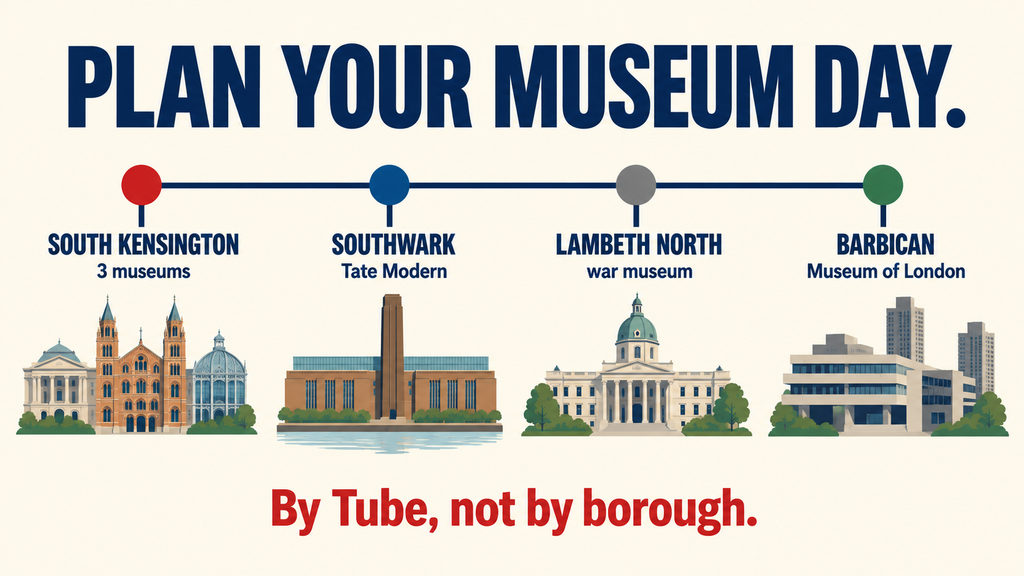
South Kensington is the destination station — about a seven-minute walk via the Exhibition Road subway. The same station also serves the V&A and the Science Museum, making this corner of SW7 the most efficient museum-hopping territory in London: all three in a single day if you’re selective.
After your visit: Old Brompton Road has good food and coffee options; Hyde Park is a 10-minute walk north for green space after the crowds.
4. Victoria and Albert Museum
🚇 Tube: South Kensington — Circle line · District line · Piccadilly line
The V&A is the world’s leading museum of art and design, spanning 5,000 years of human creativity across ceramics, fashion, textiles, jewellery, metalwork, photography and sculpture. The fashion galleries and the Cast Courts — enormous Victorian plaster casts of famous European sculptures — are perennial favourites, and the café is one of the best of any London museum.
Same station as the Natural History Museum, and the two sit practically next door on Exhibition Road. Visiting both? Start with the V&A — it opens slightly earlier, and the NHM gets busier as the day goes on.
5. Science Museum
🚇 Tube: South Kensington — Circle line · District line · Piccadilly line
The Science Museum covers technology, medicine and scientific discovery across seven floors. The free Making the Modern World gallery on the ground floor — home to Stephenson’s Rocket and the Apollo 10 capsule — is worth the visit alone. Upper floors include interactive galleries for younger visitors, and the paid IMAX theatre runs science and nature films.
Third of the South Kensington trio, all three museums within five minutes of each other on foot. Visiting with children? This is usually the most popular of the three — arrive early or come late afternoon once school groups have left.
6. Museum of London
🚇 Tube: Barbican — Circle line · Hammersmith & City line · Metropolitan line
The Museum of London traces the city’s history from prehistoric times to the present — Roman Londinium, the Great Fire, the Blitz, and the post-war communities that shaped modern London. One of the more underrated museums in the city: far fewer crowds than South Kensington, with genuinely excellent curation.
Barbican station sits on the Circle, Hammersmith & City and Metropolitan lines, with the museum a short walk through the Barbican estate — one of Europe’s great examples of Brutalist architecture, worth exploring in its own right. The Barbican Centre next door has a free foyer gallery and regular exhibitions.
After your visit: St Paul’s Cathedral is 15 minutes on foot (or one stop on the Central line). Smithfield Market and the restaurants of Farringdon and Exmouth Market are also within easy walking distance.
7. Tate Modern
🚇 Tube: Southwark — Jubilee line
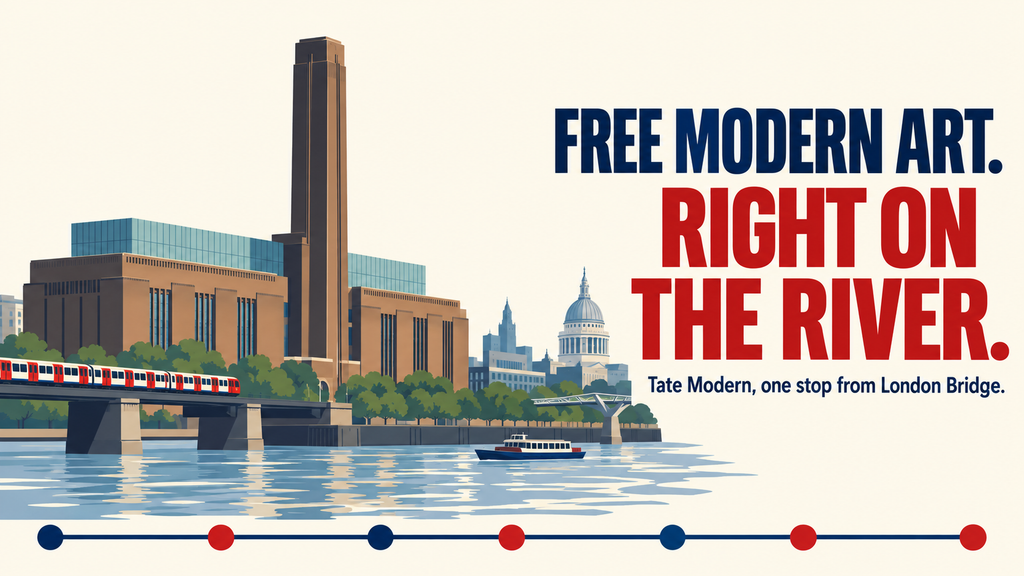
Tate Modern occupies the former Bankside Power Station on the South Bank, itself a landmark of industrial-heritage conversion. The free permanent collection spans the entire 20th century — Picasso, Rothko, Warhol, Louise Bourgeois — and the Turbine Hall installations are often extraordinary.
Southwark station on the Jubilee line is closest, around eight minutes on foot. You can also walk from London Bridge (Northern and Jubilee lines) along the South Bank — about 15 minutes, past Borough Market and the Golden Hinde.
After your visit: Cross the Millennium Bridge on foot for a striking approach to St Paul’s. East along the river takes you past Shakespeare’s Globe, Borough Market (best Thursday or Saturday), and London Bridge.
8. Imperial War Museum
🚇 Tube: Lambeth North — Bakerloo line
The Imperial War Museum covers the history of modern warfare from the First World War to the present, with exhibits on the Holocaust, the Blitz and more recent conflicts — thoughtfully curated, and honest without glorifying conflict. The WWI galleries are among the best in London.
Lambeth North on the Bakerloo line is nearest, around five minutes on foot. It’s one of the quieter Bakerloo stops, which means the museum sees far fewer visitors than its quality deserves.
After your visit: The Garden Museum, in a converted church next to Lambeth Palace, is a short walk away. Cross Lambeth Bridge for Westminster and the Houses of Parliament, or head along the Albert Embankment toward the South Bank.
Planning Your Museum Day by Tube
The most efficient museum-by-Tube combinations depend on which line you’re travelling:
- Piccadilly line: South Kensington covers the Natural History Museum, V&A and Science Museum — three world-class institutions within five minutes of each other. Ride one stop to Knightsbridge for Harrods, or two stops to Green Park for St James’s Park.
- Jubilee line: Southwark for Tate Modern, one stop to London Bridge for Borough Market and the South Bank.
- Bakerloo line: Lambeth North for the Imperial War Museum, then two stops north to Charing Cross for the National Gallery and Trafalgar Square.
- Metropolitan, Circle or Hammersmith & City lines: Barbican for the Museum of London, then east to Liverpool Street for Shoreditch and Spitalfields, or west to King’s Cross for the British Library.
All eight museums have free cloakrooms if you’re carrying a bag. Most have cafés on site, though quality varies — the V&A’s is the best of the group.
The Tube Makes It Easy
London’s free museums are spread across the city, but the Underground connects almost all of them with a single change or less. That’s one of the great underappreciated facts about the Tube — it doesn’t just move you between zones, it unlocks London’s cultural geography in a way no other city’s transit system quite matches.
Planning your first London visit, or just trying to make the most of a single day? Organising your route by line rather than by borough is almost always the more efficient approach. Explore by line, plan by station — that’s the whole idea behind this site.