King’s Cross & St Pancras by Tube: The Complete Local Guide
There is no station in London that works harder than King’s Cross St Pancras. Six Tube lines converge here, Eurostar trains depart for Paris and Brussels, and the surrounding neighbourhood — once a byword for post-industrial neglect — has become one of the city’s most genuinely exciting places to spend a day.
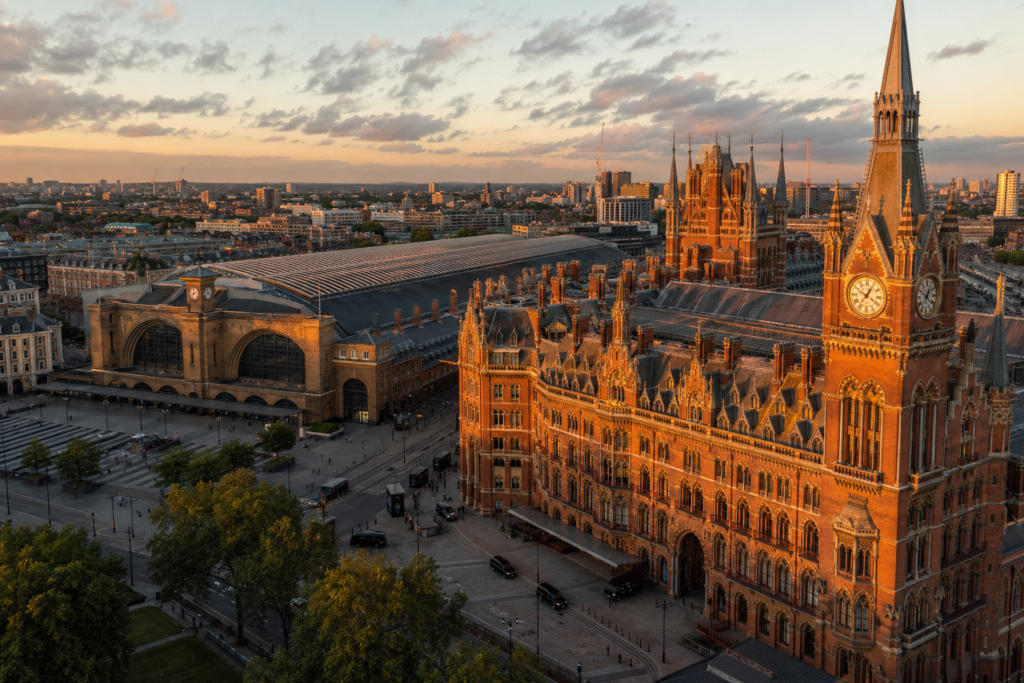
This is the guide for making the most of it: whether you have an hour to kill between connections, an afternoon to explore, or you’re using King’s Cross as the anchor for a longer London trip.

Why King’s Cross Became One of London’s Most Interesting Neighbourhoods
For most of the twentieth century, King’s Cross was a place you passed through rather than a destination in its own right. The area around the station was rough-edged, the Victorian infrastructure felt like a relic, and the canal at the back was industrial rather than scenic.
The transformation that followed — driven by the Eurostar terminal, the redevelopment of the Granary Square and King’s Cross Central site, and the relocation of Central Saint Martins to the area — created something unusual in London: a genuinely new neighbourhood built on the bones of a Victorian freight terminal. The result is a place that feels both historic and self-consciously contemporary, with some of London’s best street food, public spaces that actually work, and a concentration of galleries, restaurants, and bars that would be the centrepiece of most other London areas.

The Underground connection is remarkable. Six lines serve King’s Cross St Pancras, making it one of the best-connected stations in the city — which also means it is one of the busiest. Navigating it efficiently (especially the Tube interchange corridors) is something of an art form, but once you surface and get your bearings, the neighbourhood rewards exploration on foot.
12 Things to Do Within 10 Minutes’ Walk
1. Granary Square
The centrepiece of the King’s Cross regeneration and arguably the best new public space built in London in the last twenty years. The square fronts the Regent’s Canal and features a grid of over a thousand choreographed fountain jets that are genuinely spectacular on a summer evening. Surrounding it are restaurants, outdoor seating, and the Central Saint Martins building — originally a Victorian granary, now one of the world’s leading art and design schools. Free to visit and worth lingering in.
2. Coal Drops Yard
A short walk from Granary Square, Coal Drops Yard is a retail and dining development built inside two Victorian coal-dropping arches that once served the Midland Railway. The architecture — particularly the swooping roof that joins the two arches, designed by Thomas Heatherwick — is worth seeing even if you are not a shopper. The mix of independent and mid-range brands is better curated than most London shopping destinations, and the restaurant and bar options are strong.
3. The British Library
One of the great free institutions in London, and one that most visitors overlook because it lacks the obvious draw of a natural history dinosaur or a Greek friezes gallery. That is a mistake. The permanent collection includes the Codex Sinaiticus, the Magna Carta, original Beatles lyrics, and Lewis Carroll’s manuscript for Alice’s Adventures Underground (fittingly, given where you are). The free galleries rotate excellent temporary exhibitions, and the building itself — controversial when it opened in 1998, beloved now — is worth an hour of your time.
4. Regent’s Canal Walk
From King’s Cross, the Regent’s Canal runs west to Camden and east towards Hackney. Either direction offers a genuinely pleasant way to walk away from the station noise and into some of London’s most varied street-level scenery. West toward Camden takes around 25 minutes on foot; east toward Angel is similar. The towpath is well-maintained and rarely crowded outside summer weekends.
5. St Pancras Station
Even if you are not catching a Eurostar, St Pancras is worth stepping inside. The Victorian Gothic exterior by George Gilbert Scott is one of London’s most dramatic building faces, but the interior — particularly the restored Barlow train shed — is even more impressive. The champagne bar in the station claims to be the longest in Europe. Spend ten minutes just looking up.
6. Platform 9¾ at King’s Cross
Yes, it is a tourist trap. Yes, it is always crowded. And yes, if you have children with you (or any residual affection for Harry Potter), it is worth queuing briefly for the photograph. The actual platform used for filming was Platform 4, but the official installation between platforms 9 and 10 is well-maintained and includes a small Harry Potter merchandise shop if you need a keepsake.
► Book Harry Potter Studio Tour tickets in advance via GetYourGuide — the tour runs from Watford Junction and sells out weeks ahead.

7. Camley Street Natural Park
Tucked between the canal and the back of King’s Cross station, Camley Street Natural Park is a two-hectare urban nature reserve that most visitors have no idea exists. It opened in 1984 on the site of a former coal yard and is managed by the London Wildlife Trust. The mix of woodland, meadow, and pond habitat is genuinely wild-feeling given its location. Free entry, open most days.
8. House of Illustration / Quentin Blake Gallery
Rennaming in 2020 as the Quentin Blake Gallery, this small institution near Granary Square is the UK’s only public gallery dedicated to illustration. Temporary exhibitions rotate throughout the year and tend to be high quality. It is compact enough to visit in under an hour, and the gift shop is excellent for children. A small admission fee applies for some exhibitions.
9. Central Saint Martins
The Granary Building that houses Central Saint Martins is open to the public, and the college runs exhibitions, public events, and open studio days throughout the academic year. Even outside of formal events, the atrium and exhibition spaces are worth a look — this is where some of the most significant British designers, artists, and filmmakers trained, and the building hums with that energy.
10. The Guardian Statue and German Gymnasium
The German Gymnasium, built in 1864 as London’s first purpose-built gym, now operates as a restaurant in a magnificent double-height Victorian space. Opposite, the angular guardian statue by Antony Gormley has become something of a neighbourhood landmark. Both are worth a five-minute detour on any walk through the King’s Cross development.
11. York Way Murals and Street Art
The streets east of the main development — particularly along York Way and Goodsway — have accumulated significant street art over the years, and some of the pieces are substantial. It is not Shoreditch in terms of density, but the walk is worthwhile and takes in a grittier side of the neighbourhood that balances the polished Granary Square experience.
12. Gasholders London
Three Victorian gasholder frames, carefully dismantled and rebuilt as a ring of luxury apartments, form one of the most striking architectural set pieces in London. The frames are Grade II listed and the circular courtyard at their centre is openly accessible. Worth a short detour for anyone interested in industrial architecture or the history of how cities repurpose infrastructure.
Best Places to Eat and Drink Near King’s Cross
Caravan King’s Cross
One of the first restaurants to open in the Granary Square development and still one of the best. The menu is all-day and broadly international, with excellent brunch options and a coffee roastery on site. Tables inside the former granary building are worth the wait; the outdoor terrace works well in summer.
► Reserve a table in advance — Caravan is consistently busy at weekends.
Dishoom King’s Cross
The King’s Cross branch of London’s most beloved Indian restaurant group is housed in a former Victorian railway goods shed and is possibly the most atmospheric dining room in the neighbourhood. The bacon naan at breakfast is a London institution. Expect queues for walk-ins; bookings are available and recommended for evenings.
► Book ahead via the Dishoom website — evening slots go quickly.
Barrafina Coal Drops Yard
A branch of the acclaimed Spanish tapas restaurant, tucked inside Coal Drops Yard. The counter seating and no-reservations policy mean queuing is often involved, but the quality of the food — particularly the seafood — justifies the wait. Go at off-peak times if possible.
Spiritland
A restaurant and music venue near King’s Cross focused on high-quality audio and food that takes itself seriously without being difficult. An excellent option for an evening that moves from dinner into live music or DJ sets, and one of the few venues in the area with genuine character.
Pubs Worth Visiting
The Parcel Yard inside King’s Cross station is a Fuller’s pub built into the former parcel office and is the best option for a drink before catching a train — high ceilings, reasonable food, and an easy ten-minute walk to any platform. For something with more local character, The Big Chill Bar on Pentonville Road has been a neighbourhood fixture for years and handles a mixed crowd well.
Day Trip Options from St Pancras International
St Pancras is the London terminus for Eurostar, which makes King’s Cross the departure point for some of the most accessible European day trips available from any major city.

Paris
The journey time to Paris Gare du Nord is around 2 hours 15 minutes on the fastest services. With trains running from early morning until late evening, a day trip is genuinely practical — enough time for a neighbourhood walk, a lunch, and a museum visit. Booking well in advance significantly reduces the ticket price.
► Book Eurostar tickets via the official Eurostar website for best prices — Snap fares for day trips can be exceptional value.
Brussels
Around 1 hour 50 minutes from St Pancras, Brussels is arguably the better day trip option for food and beer. The Grand Place, the Art Nouveau architecture of the Saint-Gilles neighbourhood, and the concentration of Belgian beer bars around the Delirium district can all be covered in a well-planned day.
Cambridge
Cambridge is 50 minutes from King’s Cross on a fast service — close enough for a half-day trip. The college backs, the Fitzwilliam Museum, and a punt on the Cam are a reasonable day’s programme that does not require a car or any planning beyond a train ticket.
► Great Northern and LNER trains run frequently from King’s Cross — check Trainline or the LNER website for advance fares.
York
Approximately 1 hour 50 minutes on the LNER East Coast Mainline from King’s Cross. The Shambles, York Minster, the National Railway Museum (free entry), and the medieval city walls can be covered in a long day. The train journey itself, particularly north of Peterborough, is pleasant.
Getting Here: Practical Information
Which Tube Lines Serve King’s Cross St Pancras?
Six lines serve King’s Cross St Pancras, making it the second-busiest interchange on the network after Waterloo. The lines are:
- Victoria line — fast, frequent connections to Brixton, Stockwell, Pimlico (south) and Highbury & Islington, Seven Sisters (north)
- Piccadilly line — direct connections to Heathrow Airport, Leicester Square, Green Park, and east to Cockfosters
- Northern line — two branches: the Charing Cross branch (west) reaches Waterloo, London Bridge, Camden; the Bank branch runs to the City. Check platform signs.
- Circle line — connects King’s Cross to Farringdon, Barbican, Liverpool Street, and the western stretch including Paddington and Notting Hill Gate
- Metropolitan line — fast services northwest to Harrow, Watford, and the Chilterns
- Hammersmith & City line — shares platforms with the Metropolitan and Circle lines; runs east to Whitechapel and west to Hammersmith
Step-Free Access
King’s Cross St Pancras has step-free access from street level to all six Tube lines, making it one of the most accessible interchange stations on the network. Step-free routes exist between the Tube platforms and both the King’s Cross and St Pancras main line platforms, as well as to the Eurostar terminal.
Note: Step-free access routes within the station can be long and involve specific lifts — check the TfL step-free guide before visiting if mobility is a concern.
Nearest Car Parks
There is no affordable on-street parking near King’s Cross. The nearest NCP car parks are on Goods Way and York Way — booking in advance via the NCP website is significantly cheaper than turning up. Realistically, this is a station best accessed by public transport, and the Tube connections are comprehensive enough to arrive from almost anywhere in London without driving.
Cycling
Santander Cycles docking stations are available outside both the King’s Cross and St Pancras entrances. The canal towpath west to Camden and east toward Angel are accessible cycling routes, though the towpath itself is shared with pedestrians and cycling should be courteous and slow.
Explore Further: More from London By Tube
King’s Cross St Pancras sits at the junction of six Tube lines — which means it is an excellent base for almost any direction London travel. Here is how it connects to the rest of the site:
- The Northern line — take it south to London Bridge (Borough Market, the Shard, Tate Modern) or north to Camden and Brixton
- The Victoria line — south to Pimlico for Tate Britain, or north to Highbury & Islington
- The Piccadilly line — west toward the West End, or east to Canary Wharf via a change
- The Metropolitan line — the backbone of northwest London and the site’s most comprehensive existing guide
- Planning a full London trip? See the First-Time Visitor 3-Day Itinerary for a Tube-based route that uses King’s Cross as a staging post on Day 1