Behind London’s Underground Station Names
The London Underground map is a tapestry of fascinating names that tell the story of Britain’s capital through the ages. From ancient villages to royal connections, each of the underground station names offers a glimpse into London’s rich history.
Ancient Origins and Saxon Settlements
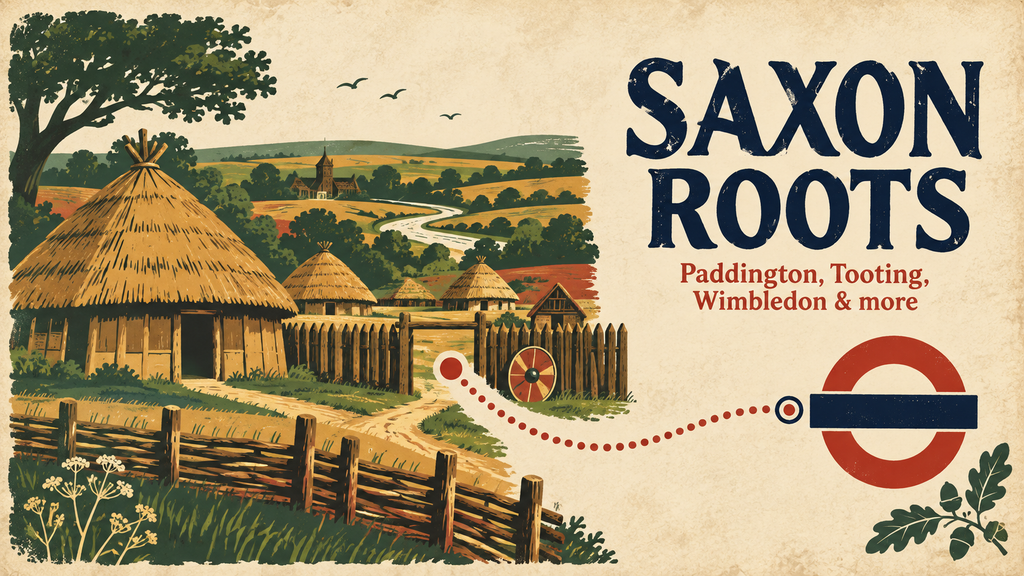
Many of London’s most familiar Tube stations take their names from Anglo-Saxon settlements.
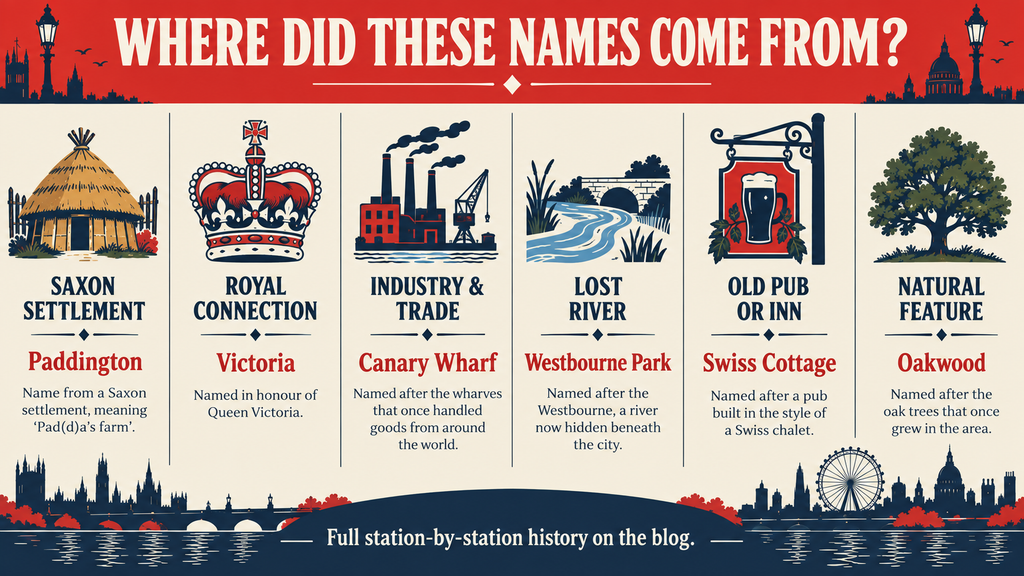
- Paddington derives from the Old English “Padda’s town,” named after a local Saxon chieftain.
- Kennington means “settlement of Cena’s people”
- Tooting comes from the Saxon tribe of Tota.
- Wimbledon originates from “Wynnman’s hill” or “Wynnman’s dun,” where ‘dun’ meant hill.
- Harrow comes from the Old English “hearg” meaning temple or sacred grove, suggesting a pagan worship site.
- Balham derived from “Baleha’s homestead”
- Peckham from “Pecca’s settlement”
This demonstrates how deeply Saxon naming patterns are woven into London’s fabric.
Natural Features and Landmarks
Several stations were named after local geographical features.
- Blackfriars takes its name from the Dominican monks who wore black robes and established a priory there in 1276. Angel station remembers a 17th-century inn called “The Angel,” which served as a crucial stopping point for travelers.
- Seven Sisters was named after a circle of seven elm trees planted around a walnut tree in the 1730s.
- Oakwood, predictably, was named after a prominent local wood
- Highgate got its name from a high toll gate that stood atop the hill.
- Woodford refers to a ford in the woods that crossed an ancient pathway
- Fairlop was named after a massive oak tree that hosted annual fairs beneath its spreading branches.
Royal Connections
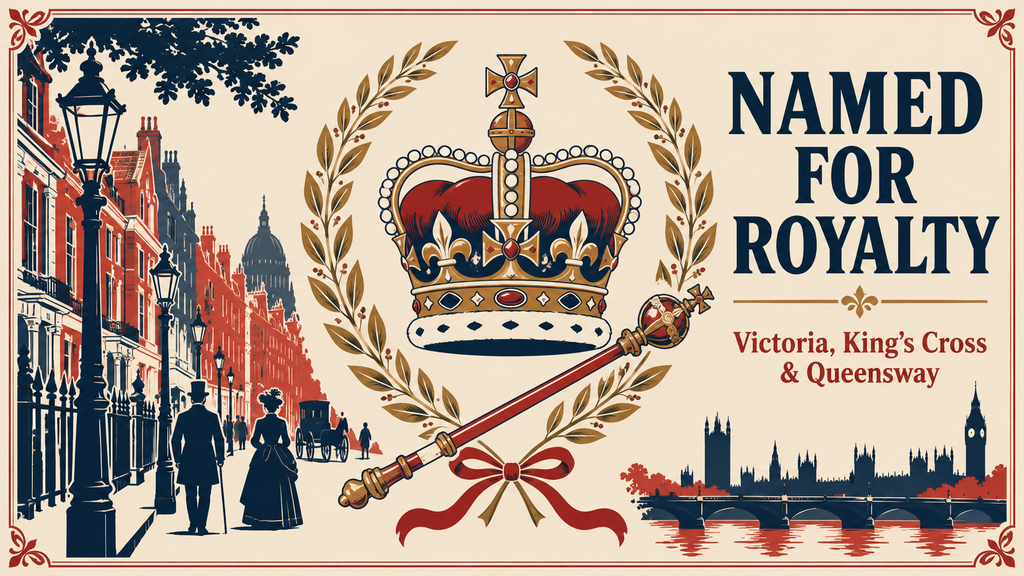
- Victoria honors Queen Victoria, but the station actually took its name from Victoria Street, built in 1851 to honor the monarch.
- King’s Cross has a more unusual royal connection – it was named after a monumentally ugly statue of King George IV that stood at the crossroads from 1836 to 1845.
- St. James’s Park station reflects its proximity to the royal park created by Henry VIII.
- Queensway was renamed from Queen’s Road in honor of Queen Victoria, who was born at nearby Kensington Palace.
- Prince Regent station was named after George IV when he served as Prince Regent during his father’s illness.
- Royal Oak takes its name from a tree in which Charles II allegedly hid after the Battle of Worcester.
Industrial Heritage
Many station names reflect London’s industrial past.
- Ironically, Shepherd’s Bush wasn’t named for shepherds but for the thorny bushes where shepherds would rest while watching their flocks en route to London’s markets.
- Arsenal is the only station named after a football club.
- Wapping recalls the place where ships’ ropes were made, from the Old English ‘wæpping’.
- Limehouse was where medieval lime kilns operated to produce mortar for London’s buildings.
- Silvertown was named after S.W. Silver’s rubber factory, established there in 1852.
- Mill Hill East references the windmill that stood there from the 16th to the 19th century.
Underground Station Names: Lost Rivers and Streams
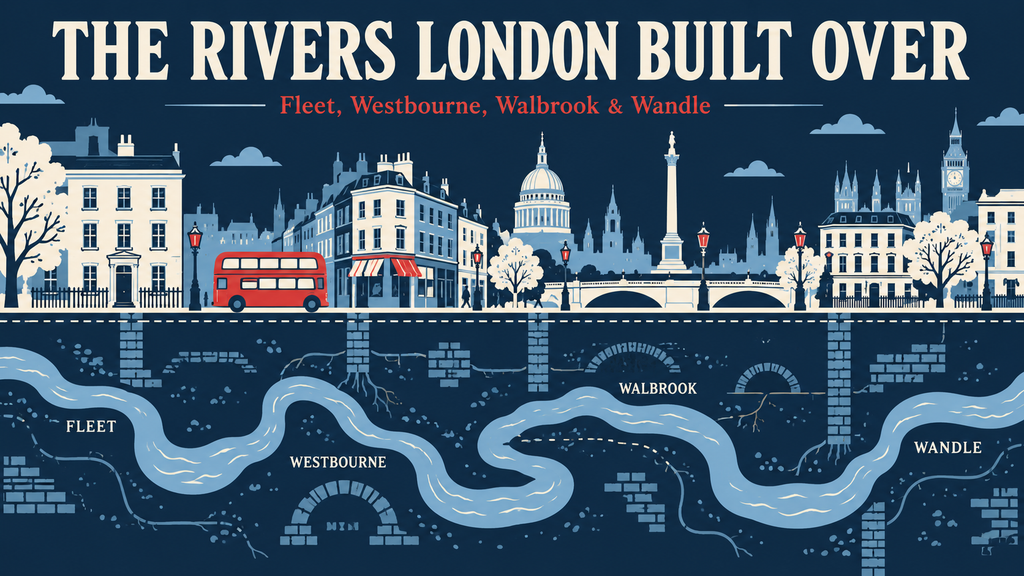
Several stations take their names from London’s forgotten waterways.
- The River Fleet gives its name to Fleet Street and Holborn (from “Old Bourne” meaning stream).
- Tyburn station (now Marble Arch) was named after a stream where public executions were carried out for centuries.
- Westbourne Park marks the course of the now-underground Westbourne River.
- Walbrook station sits above its namesake river, which was vital to Roman London.
- The Ravensbourne River influenced the naming of Ravensbourne station
- The River Wandle gave Wandsworth its name.
Strange Tales and Mysteries
Some station names have more mysterious origins.
- Manor House station isn’t named after any specific manor house – it takes its name from a pub.
- The origin of Elephant & Castle has been debated for years.
- Swiss Cottage station was named after an 1804 inn built in the style of a Swiss chalet.
- Cockfosters’ unusual name might derive from “the residence of the chief forester” or a family named Cock who held land in the area.
- White Chapel station gets its name from a white church of St. Mary that was originally built from white chalk rubble.
- The name Mudchute derives from the mud dumped there from the dredging of Millwall Docks.
Underground Station Names: Modern Developments
Not all station names are ancient.
- Canary Wharf gets its name from the sea trade with the Canary Islands – the wharves where their ships would dock.
- The newest station names tend to be more descriptive of their locations, like Heathrow Terminals 2 & 3 or Nine Elms.
- Canada Water was named in 1999 after the former Canada Dock, itself named for trade with Canada.
- Custom House draws its name from the nearby Custom House for the Port of London.
- North Greenwich isn’t actually in Greenwich at all – it’s on the Greenwich Peninsula, demonstrating how modern naming can sometimes be more about creating connections than geographical accuracy.
These names paint a vivid picture of London’s evolution from a Roman settlement to a medieval town, through the industrial revolution, and into the modern era. Each station name provides a unique window into a different aspect of the city’s rich history, preserving stories that might otherwise have been lost to time.
More from London By Tube: