What to Do Near Oxford Circus Station: Shopping, Culture & Hidden Gems
Central Line · Victoria Line · Bakerloo Line | Zone 1 | Last updated: April 2026
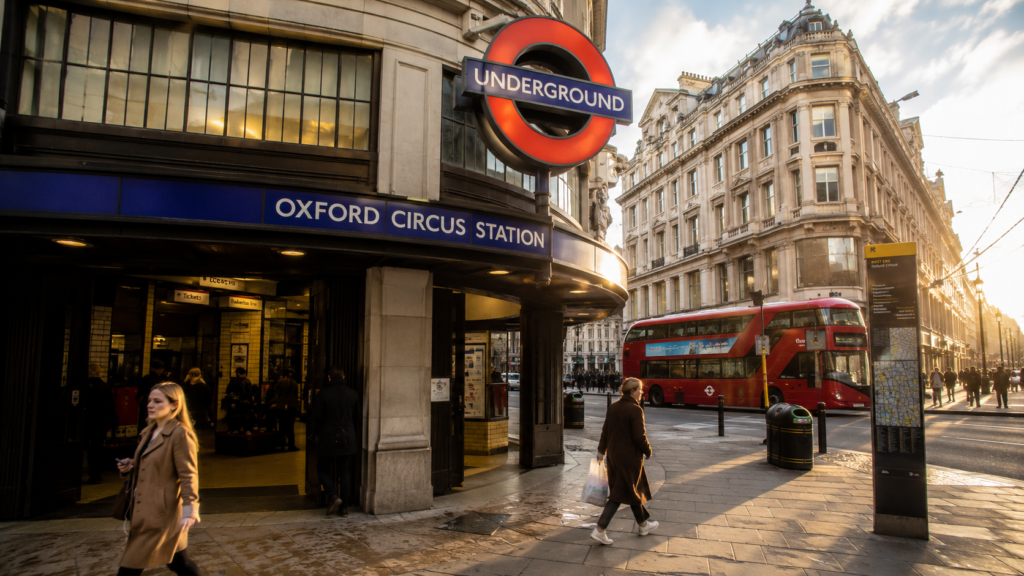
Few stations in London carry as much weight as Oxford Circus. Three lines converge here — the Central, Victoria, and Bakerloo — making it one of the busiest interchange points on the entire Underground network. Step out of any of its four exits and you’re immediately absorbed into one of London’s most commercially intense and culturally layered neighbourhoods.
But Oxford Circus is more than a shopping thoroughfare. Scratch beneath the surface and you’ll find independent boutiques tucked into Carnaby Street’s lattice of alleys, world-class contemporary art in Mayfair a short walk south, one of London’s finest parks to the north, and a handful of genuinely excellent places to eat and drink that most visitors walk straight past.
This guide covers everything within roughly ten minutes on foot from Oxford Circus station — organised, as always, by what’s worth your time.
💡 Tube Tip: Oxford Circus has four street-level exits. For Regent Street, use the south exit. For Carnaby Street and Soho, head east on Oxford Street then south. For John Lewis and the western end of Oxford Street, use the north-west exit.
Shopping: Beyond the High Street
Oxford Street itself needs no introduction — it’s one of the world’s most visited retail corridors. But if you’ve come to simply queue for Primark or browse the Topshop site that still hasn’t quite recovered, this guide probably isn’t for you. Here’s what’s actually worth seeking out.
Carnaby Street & the Liberty Lanes
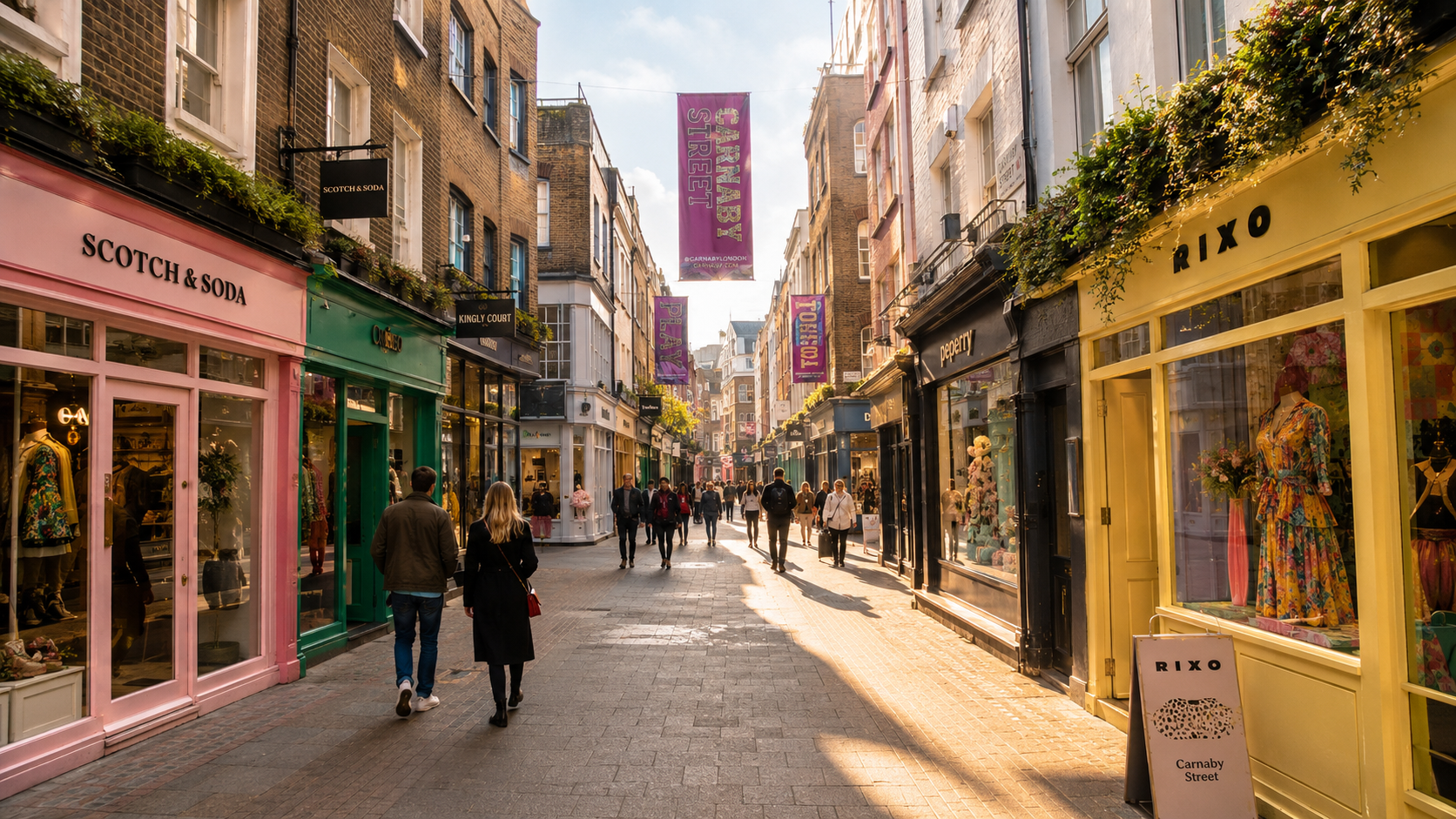
Five minutes east of Oxford Circus, Carnaby Street retains a genuine character that Oxford Street itself has largely lost. The pedestrianised street and its web of surrounding alleys — Newburgh Street, Kingly Court, Foubert’s Place — are home to independent streetwear labels, specialist shoe shops, and some of the more interesting vinyl and book dealers in central London.

Kingly Court in particular is worth navigating: a three-storey outdoor courtyard that feels like Soho’s better-kept secret. Street food traders occupy the ground floor, independent boutiques line the upper levels, and the whole thing has a density of good options rarely found this close to Zone 1’s tourist core.
Liberty London
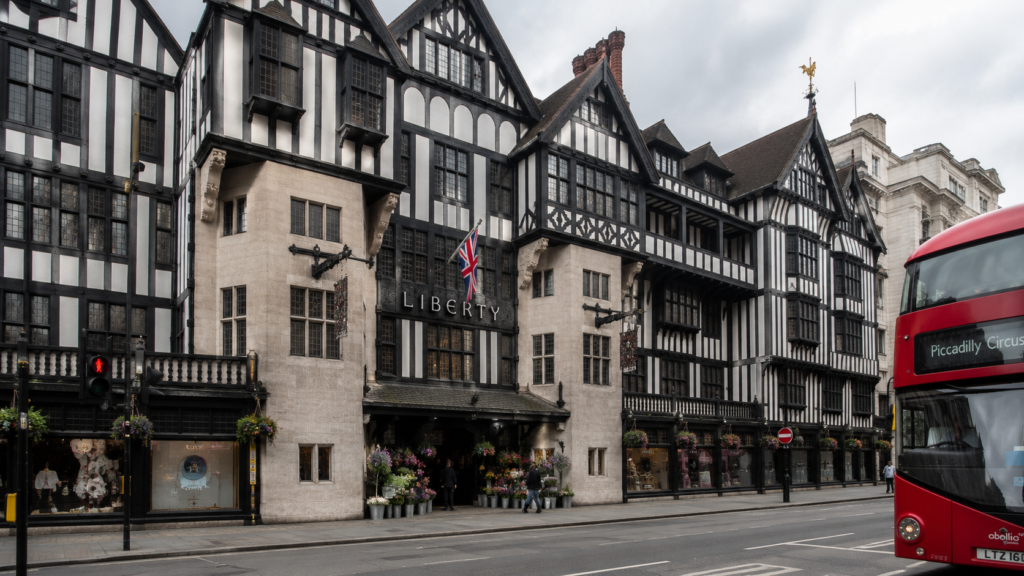
A ten-minute walk south-west of the station brings you to Liberty on Great Marlborough Street — one of London’s genuinely distinctive department stores. The mock-Tudor building alone is worth the detour, but the interior justifies it further: Liberty stocks designers and independent brands that you won’t find replicated anywhere else on Oxford Street, alongside their famous floral-print fabric department which has been there since 1875.
Liberty’s fabric hall in particular is a London institution. If you’re interested in print, textiles, or design, budget at least an hour. Nearest exit: Great Marlborough Street (south exit from Oxford Circus, then five minutes west).
Regent Street
The curved sweep of Regent Street running south from Oxford Circus is one of the more architecturally satisfying shopping streets in Europe — John Nash’s original 1820s vision is still legible in the colonnaded facades. The retail offering skews toward aspirational high street (Apple, Anthropologie, the Disney Store, Jo Malone) rather than the truly independent, but as a street to walk it is considerably more pleasant than Oxford Street.
The stretch south toward Piccadilly Circus takes around twelve minutes on foot and passes the original Hamley’s toy shop, which, despite being a tourist trap, remains genuinely impressive in scale if you’re travelling with children.
💡 Tube Tip: Avoid Oxford Street between 12pm and 6pm on Saturdays if you can. The crowds between Bond Street and Oxford Circus are some of the densest in London. Weekday mornings are noticeably calmer and the shops are less picked over.
Culture: Art, History & Architecture
The area around Oxford Circus punches well above its weight culturally, given how thoroughly it’s associated with retail. Several of London’s best smaller galleries and institutions sit within an easy walk.
The Photographers’ Gallery
🚇 Ramillies Street · Free entry (some exhibitions ticketed) · 5 min walk
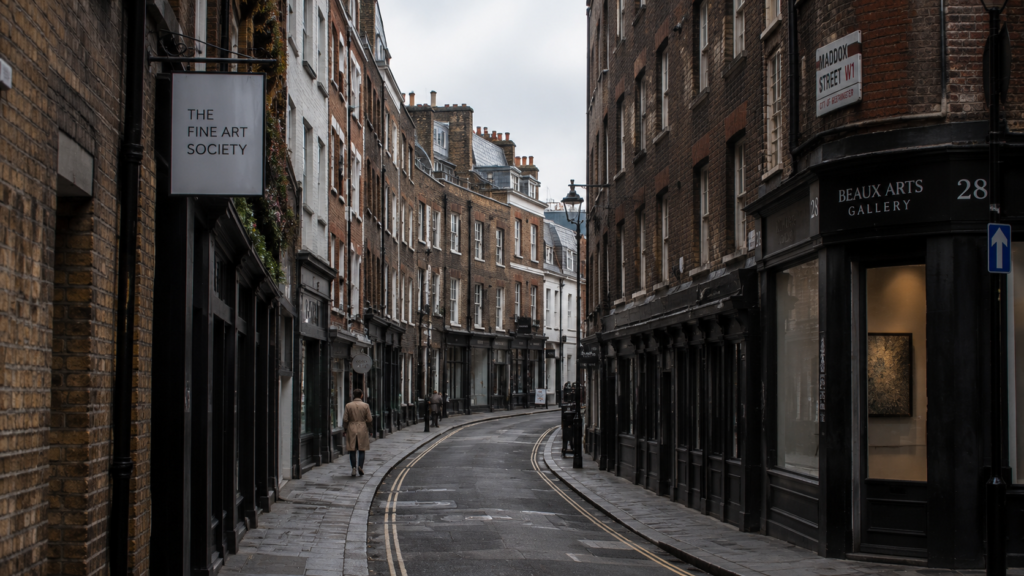
Tucked into a side street just north of Oxford Circus, the Photographers’ Gallery is the UK’s largest public gallery dedicated to photography. The main exhibition space rotates every few months and consistently brings in work that wouldn’t look out of place in a major international festival. The bookshop on the ground floor is one of the best photography bookshops in London — a strong argument for the detour even if the exhibition isn’t immediately your thing.
Entry to the ground floor and bookshop is free. Main gallery admission is typically £5–8 but free on the last Friday afternoon of each month.
Oxford Street’s Art Deco Underground Architecture
🚇 Oxford Circus Station · Free · On your doorstep
Before you leave the station, it’s worth pausing at the tilework and signage. Oxford Circus station was rebuilt in the 1920s to designs by Charles Holden, the architect responsible for many of the Underground’s finest stations. The quadrant layout — with its four symmetrical corner entrances — is unusual on the network and was designed specifically to manage the enormous passenger flow that the interchange generates. It’s a piece of engineering and design working together in a way that’s easy to miss when you’re rushing through.
Wallace Collection
🚇 Manchester Square · Free · 15 min walk or one stop to Bond Street
Technically just beyond our ten-minute radius, but worth including because it is one of London’s genuinely unmissable free museums and routinely overlooked by visitors. The Wallace Collection occupies an 18th-century townhouse in Manchester Square and contains Frans Hals’s The Laughing Cavalier, Rubens, Watteau, Poussin, and one of the finest collections of French furniture and decorative arts outside France — all in rooms that feel more like visiting a private house than a conventional museum.
Entry is free. The café in the courtyard is a good spot for lunch if you’re making a half-day of the area.
Handel & Hendrix in London
🚇 Brook Street, Mayfair · Ticketed · 15 min walk south
One of London’s more unusual museums: the Georgian townhouses at 25 Brook Street were home, at different points, to both George Frideric Handel (who lived there for 36 years) and Jimi Hendrix (who rented the flat directly above Handel’s rooms for a year in 1968–69, apparently unaware of the connection until told by a neighbour). The museum explores both figures and the contrast between their centuries is genuinely fascinating. Admission is around £15 for adults; check the website for current prices.
💡 Tube Tip: If you’re interested in London’s art scene, the Mayfair gallery district — Cork Street, Dover Street, and the surrounding streets — is a 15-minute walk south and contains some of the city’s most significant commercial galleries. Most are free to enter.
Green Spaces: Where to Breathe
Regent’s Park
🚇 10 min walk north, or take the Bakerloo line one stop to Regent’s Park
Oxford Circus’s most significant green space is Regent’s Park, a ten-minute walk north along Portland Place or a single stop on the Bakerloo line to Regent’s Park station. The park covers 395 acres and contains the Open Air Theatre (one of London’s best summer venues), the boating lake, the formal rose garden, and the outer rim of London Zoo.
The walk north along Portland Place is itself worth taking: the street is lined with embassies and early 19th-century townhouses, and the BBC Broadcasting House sits at the south end where it meets Langham Place.
Cavendish Square Garden
🚇 2 min walk from Oxford Circus · Free
Almost directly above Oxford Circus station to the north, Cavendish Square Garden is a small but well-maintained formal garden that most people using the station walk straight past. Benches, mature plane trees, and a surprising degree of quiet given the immediate context. Good for a ten-minute reset if Oxford Street has become overwhelming.
Food & Drink: The Best Options Close By
The immediate vicinity of Oxford Circus suffers, predictably, from a high concentration of tourist-trap restaurants. These recommendations are all within 10 minutes on foot and represent genuine value rather than convenience.
Hoppers — Soho
🚇 Frith Street · Sri Lankan · ££ · 12 min walk east
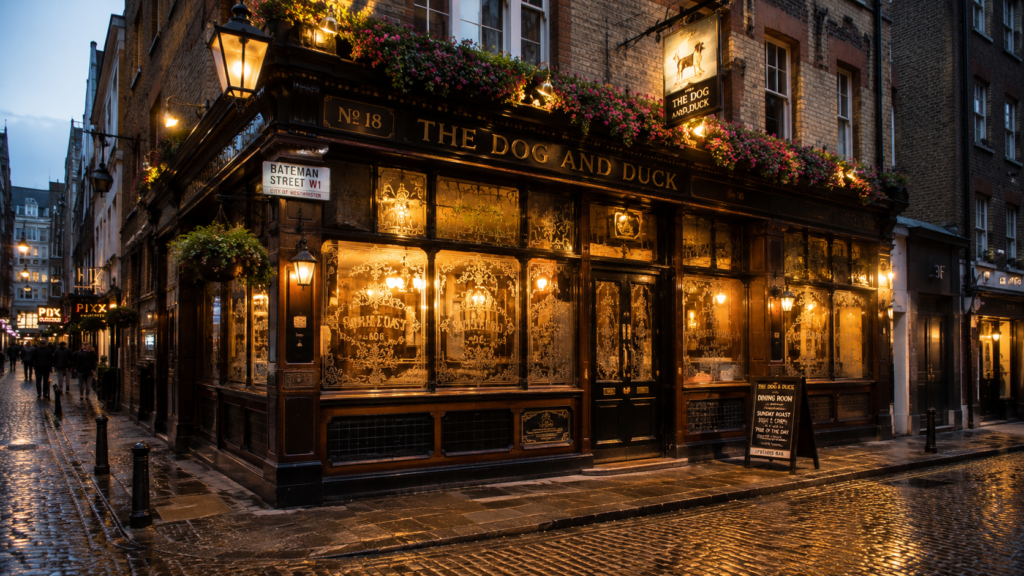
One of London’s most consistently praised casual restaurants, serving Sri Lankan hoppers (bowl-shaped rice and coconut crepes), kari, and sambols. No bookings — arrive when it opens or expect to queue. Worth it. The short Eat menu and the bone marrow varuval are particular highlights.
Bao — Carnaby
🚇 Kingly Court · Taiwanese · ££ · 6 min walk
The Carnaby outpost of the Taiwanese bao brand that made Soho queues fashionable. Small, precise, and genuinely good. The classic pork bao and the aged beef short rib are the dishes to order. No reservations at this location — turn up early or late.
Princi
🚇 Wardour Street, Soho · Italian bakery and café · £ · 10 min walk
A London outpost of the celebrated Milan bakery, with a long counter of wood-fired pizzas, focaccia, pastries, and daily specials. Excellent for a quick lunch or breakfast stop without the mark-up of most central London cafés. The seating can be tight at peak times but the food quality for the price point is hard to match in this part of town.
Pubs: The Argyll Arms
🚇 Argyll Street, directly adjacent to Oxford Circus station · Traditional pub · £
The Argyll Arms sits almost directly above Oxford Circus station on Argyll Street and is one of the better Victorian pubs in central London — a grade II listed building with original etched glass partitions, dark wood snugs, and a decent selection of real ales. Busy in the early evening but manageable before 5pm. A solid pint of London Pride without any pretension.
💡 Tube Tip: The concentration of mid-range chain restaurants on Oxford Street and Regent Street is best avoided at lunch. Walk two streets south into Soho and prices drop considerably while quality increases significantly. Berwick Street Market (Monday–Saturday) is particularly good for a cheap, high-quality lunch.
Hidden Gems: What Most Visitors Miss
The Oxford Street Ghost Station
Few visitors to Oxford Circus know that a disused station lies directly beneath their feet. The old Central London Railway ticket hall from 1900 is preserved below the current station, and periodic access events run through organisations like the London Transport Museum’s Hidden London programme. It doesn’t come up on every visit but if you’re interested in the Underground’s architectural history, it’s worth checking the Hidden London programme before you travel.
St George’s, Hanover Square
🚇 St George Street, Mayfair · 10 min walk south-west · Free
One of London’s most historically significant churches, built in 1724 and the parish church for much of Mayfair’s aristocratic and artistic community for the following two centuries. Handel worshipped here. Theodore Roosevelt married here. Percy Bysshe Shelley married Mary Wollstonecraft’s daughter here (his second wife; his first wife was still alive, which caused some comment). The interior is cool, quiet, and free — a useful counterpoint to the street noise outside.
Berwick Street Market
🚇 Berwick Street, Soho · Monday–Saturday · 10 min walk east
One of London’s oldest street markets, running the length of Berwick Street since the early 18th century. Primarily a fresh produce market — fruit, vegetables, herbs, street food traders — with a handful of specialist stalls. It’s been a fixture of Soho’s working character for three centuries and has survived the neighbourhood’s gentrification relatively intact. The cover of the Oasis album (What’s the Story) Morning Glory? was photographed here in 1995, which either adds or subtracts from the appeal depending on your perspective.
All Saints Margaret Street
🚇 Margaret Street · 5 min walk north · Free
Often listed among the finest Victorian Gothic churches in England. William Butterfield’s 1859 building is extraordinary: polychrome brickwork, extraordinarily rich interior decoration, and a courtyard entrance that makes the transition from Margaret Street’s mundane commerce feel deliberately theatrical. Free to enter and rarely busy. Even if Victorian Gothic is not normally your thing, this one earns its reputation.
Connected to the Rest of the Network
Oxford Circus is one of the best-connected interchanges on the Underground, giving you fast, direct access to most of central and west London.
- Central Line east → Liverpool Street (Shoreditch, City), Stratford (Olympic Park, Westfield)
- Central Line west → Bond Street (Mayfair), Notting Hill Gate (Portobello Road)
- Victoria Line north → King’s Cross St. Pancras (Eurostar, Northern connections)
- Victoria Line south → Brixton (Brixton Village, market, live music)
- Bakerloo Line north → Regent’s Park, Baker Street (Sherlock Holmes Museum)
- Bakerloo Line south → Waterloo (South Bank, National Theatre, Tate Modern connections)
→ Read our full Central Line guide for more station spotlights along the route.
→ Read our full Victoria Line guide to plan your journey south to Brixton or north to King’s Cross.
→ Read our full Bakerloo Line guide for everything along one of London’s oldest routes.
Practical Information
Lines served: Central, Victoria, Bakerloo
Zone: 1
Step-free access: No. Oxford Circus does not currently have step-free access from street to platform. The nearest step-free stations on the Victoria line are Victoria and King’s Cross St. Pancras. Bond Street (Central line, one stop west) has partial step-free access from street to the ticket hall.
Peak hours: Oxford Circus is among the busiest stations on the network. Expect significant crowding between 8–9:30am and 5–7pm on weekdays.
Night Tube: Central and Victoria lines both operate Night Tube services on Friday and Saturday nights.
Nearest bus routes: The 25, 55, 73, 98, and 176 all serve Oxford Street. The C2 runs north to Regent’s Park and Camden.
The Bottom Line
Oxford Circus rewards those who use it as a starting point rather than a destination. The shopping draw is real but limited if Oxford Street chain retail is your baseline — the surrounding streets and neighbourhoods are where the area earns its place as one of London’s most layered and walkable central zones. Budget two to three hours if you’re combining Carnaby Street, the Photographers’ Gallery, and lunch in Soho. Add another hour if you’re walking to Regent’s Park or heading south to the Wallace Collection.
The three-line interchange makes getting in and out straightforward, and the connections onward — to Brixton, Notting Hill, King’s Cross, Liverpool Street — mean Oxford Circus works well as the anchor for a day that spans multiple neighbourhoods by Tube.