What to Do Near Liverpool Street Station: A Local’s Guide to EC2
Liverpool Street is one of London’s great gateway stations — and one of its most underrated neighbourhoods. Most visitors rush through on their way somewhere else: up to Stansted, across to Bethnal Green, into the City for a meeting. That is a mistake. Step out of the station’s Victorian iron canopy and you are standing at the edge of two worlds: the Square Mile to the west, still humming with financial energy, and Shoreditch to the east, where that energy gets reinterpreted as creative restlessness. The streets in between — Old Spitalfields Market, Bishopsgate, the winding lanes of the old Huguenot quarter — are some of the most historically layered in London.

This guide is for people who want to do EC2 properly. Whether you have an afternoon between connections, a full day to explore, or you are planning a food-led east London weekend, here is what the area around Liverpool Street station has to offer.
Getting There: Liverpool Street by Tube
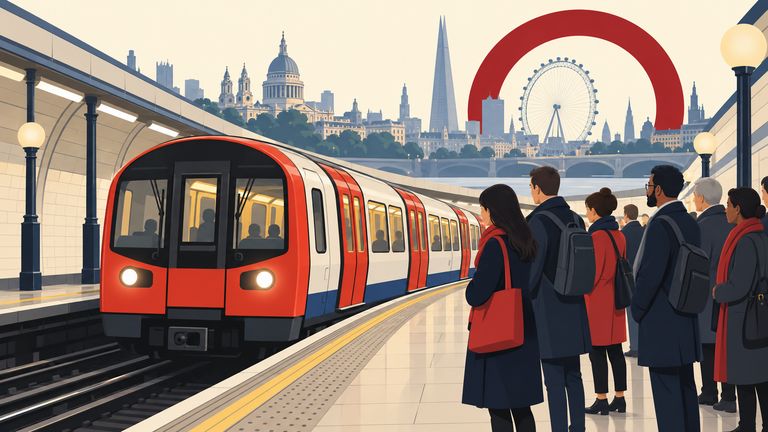
Liverpool Street is served by four Underground lines — Central, Circle, Hammersmith & City, and Metropolitan — making it one of the most connected interchange stations in the network. The Elizabeth line also runs through Liverpool Street, providing fast connections west to Paddington and Heathrow and east to Canary Wharf, Stratford, and beyond.
- Central line: direct from Oxford Circus (7 min), Notting Hill Gate (20 min), Stratford (8 min)
- Elizabeth line: direct from Paddington (10 min), Canary Wharf (6 min), Heathrow Terminal 2 & 3 (38 min)
- Circle / Hammersmith & City: connects to King’s Cross, Paddington, Hammersmith
- Metropolitan: direct from Farringdon, Baker Street, Harrow
From Liverpool Street station, every destination in this guide is within 10 minutes on foot. Exit via the main Bishopsgate exit for Spitalfields and Shoreditch. Use the Liverpool Street exit for the City and Broadgate.
→ See our Complete Central Line Guide for the full stop-by-stop breakdown.
12 Things to Do Near Liverpool Street Station
1. Wander Old Spitalfields Market
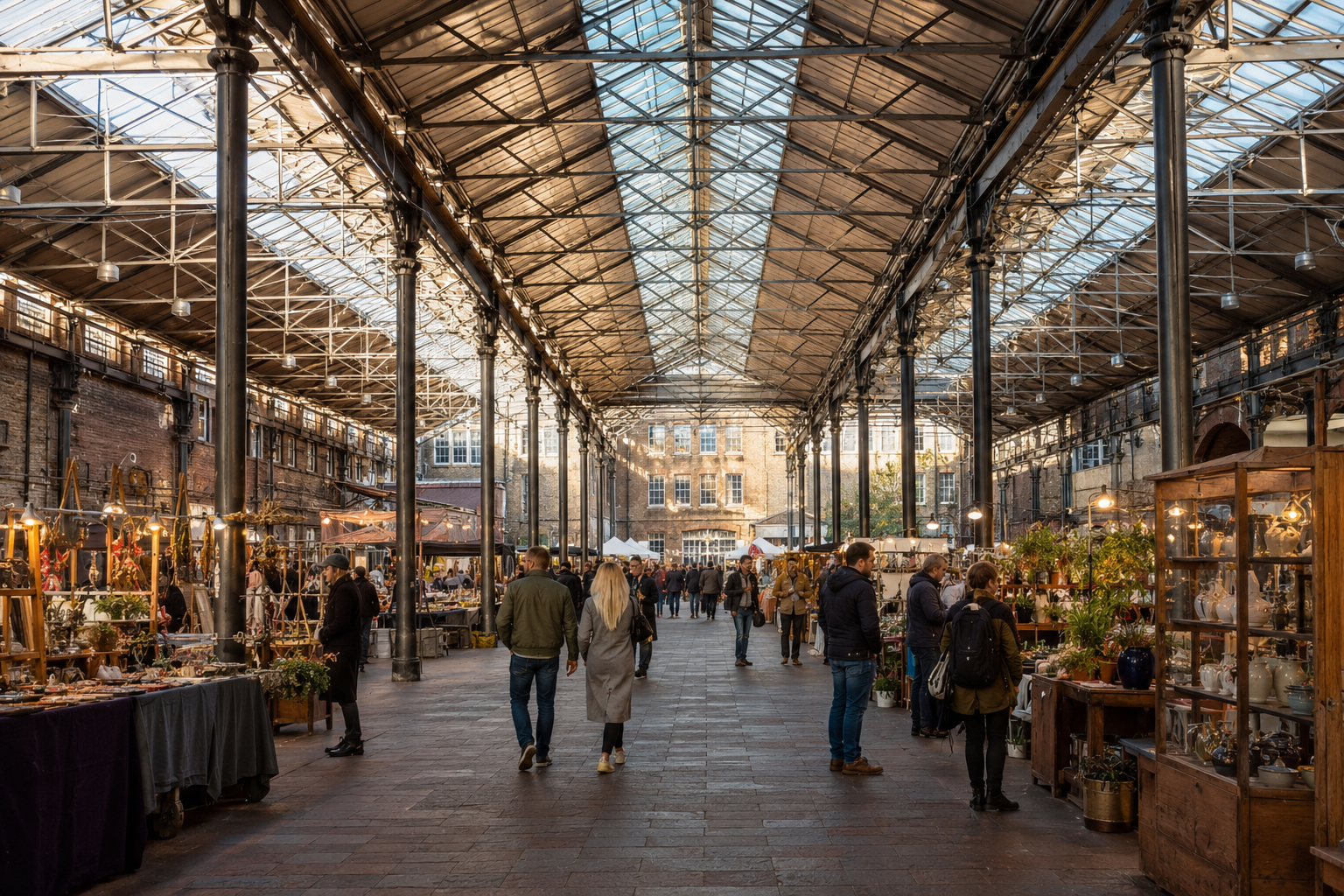
Old Spitalfields Market sits just five minutes east of the station and deserves at least an hour of unhurried time. The Victorian market building — a glorious cast-iron and glass structure — has been trading since 1638, though the current building dates to the 1880s. Today it hosts a mix of independent traders, street food vendors, and fashion and design stalls. Thursdays are particularly good for antiques and vintage; weekends bring the full market atmosphere. The surrounding streets — Lamb Street, Brushfield Street, Artillery Lane — are some of the best preserved Georgian streetscapes in London, and worth exploring slowly.
Best day to visit: Thursday for antiques; Sunday for the widest range of traders
Opening hours: Market hall open daily 10am–8pm; traders vary by day
→ Book a Spitalfields food and history walking tour via GetYourGuide
2. Eat Your Way Down Brick Lane
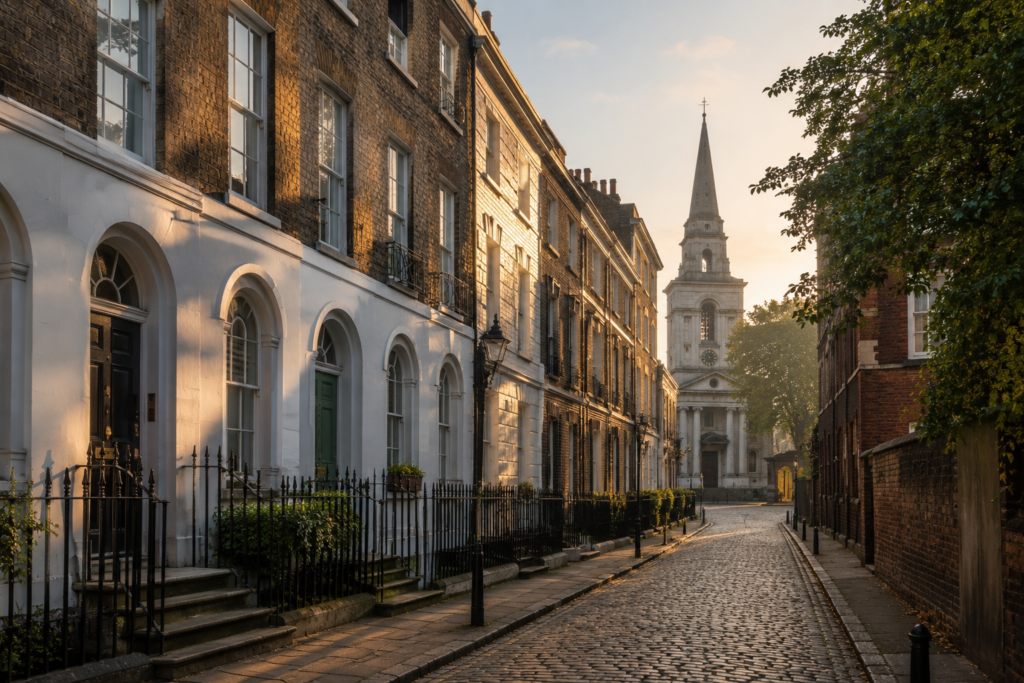
Brick Lane is ten minutes’ walk from Liverpool Street and carries more culinary history per square metre than almost anywhere else in the city. The street’s identity has been shaped by successive waves of immigration — Huguenot silk weavers, Ashkenazi Jewish tailors, Bangladeshi restaurateurs — and each has left its mark on the food. The northern end of Brick Lane is where to find the bagel shops that have been operating continuously since the 1970s: Beigel Bake at number 159 is a London institution, open 24 hours, serving salt beef bagels to night-shift workers and tourists alike. Further south, the Sunday Upmarket and Backyard Market bring together street food traders, vintage clothes, and independent art.
Don’t miss: The salt beef bagel at Beigel Bake — a London rite of passage at any hour
→ Book a Brick Lane food tour for a deeper dive into the area’s culinary history
3. Discover the Dennis Severs’ House
Folgate Street, a short walk north of Liverpool Street, is home to one of London’s strangest and most compelling attractions. Dennis Severs’ House is a Georgian townhouse that has been arranged — not as a museum, but as a ‘still life drama’ — to evoke the life of an imaginary family of Huguenot silk weavers across three centuries. Candles flicker, food is left half-eaten, fires are still burning. You are asked to enter as if the family has just stepped out. It sounds eccentric and it is; it is also genuinely extraordinary. Evening candlelit openings are available on selected Mondays throughout the year and are particularly atmospheric.
Book ahead: Monday evening Silent Night openings sell out weeks in advance
Address: 18 Folgate Street, E1 6BX
→ Book Dennis Severs’ House tickets in advance via the official website
4. Explore the Broadgate Estate
Immediately adjacent to Liverpool Street station, the Broadgate estate is not the sterile corporate plaza it might appear from the outside. The ice rink at Broadgate Circle operates through winter, and the surrounding spaces host regular free events and food markets throughout the year. The architecture is worth pausing for: Broadgate was one of the largest commercial developments in London’s history when it was completed in the late 1980s and contains some important public art, including Richard Serra’s ‘Fulcrum’ — a five-storey tall rusted steel sculpture just outside the station entrance that most commuters walk past without a second glance.
Free attraction: Richard Serra’s Fulcrum sculpture is immediately outside the station — stop and look up
5. Visit Christ Church Spitalfields
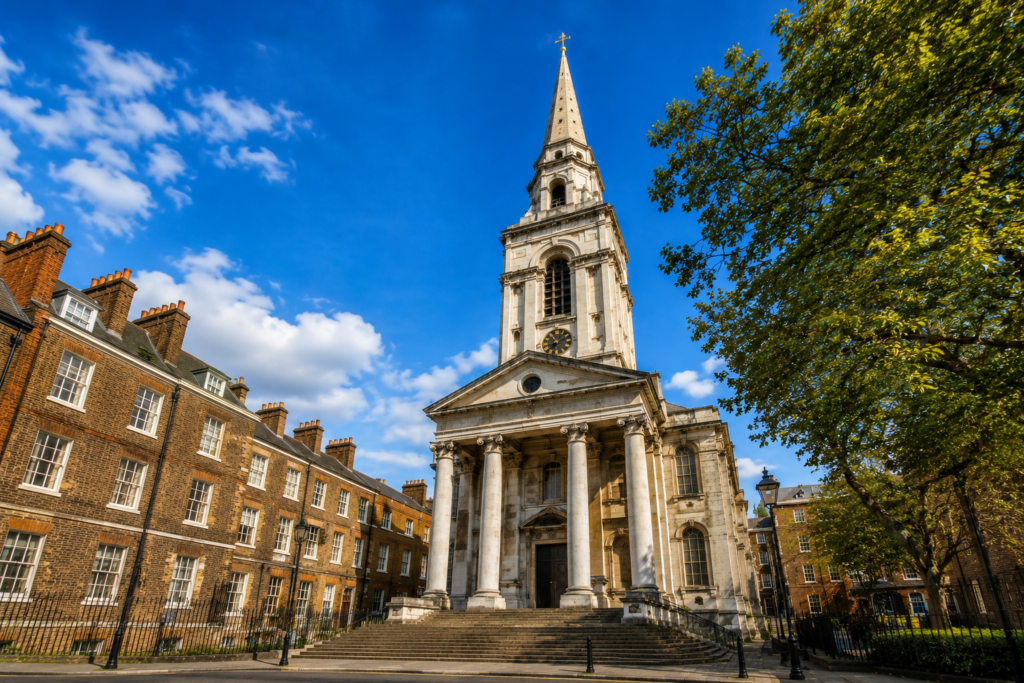
Nicholas Hawksmoor’s masterpiece stands on Commercial Street, directly across from the market, and is one of the finest baroque churches in England. Built between 1714 and 1729 as part of a programme to assert Anglican authority in what was then a strongly nonconformist area, its scale and confidence are still startling. The interior is equally dramatic: plain white walls, box pews, a huge pipe organ. The building fell into severe disrepair in the twentieth century and only reopened fully after a decades-long restoration in 2004. Entry is free; guided tours run on selected dates.
Free to enter: Open most days — check the website for guided tour dates
6. Eat at St John Bread & Wine
Fergus Henderson’s approach to cooking — simple, ingredient-led, offal-forward — changed British restaurant culture in the 1990s, and St John Bread & Wine on Commercial Street is the more accessible sibling of his flagship St John in Smithfield. The menu changes daily and includes some of the best breakfast food in east London (bone marrow and parsley salad, eccles cakes and Lancashire cheese, and a rotating selection of pastries that draw a dedicated morning queue). Lunch and dinner are excellent and not as expensive as the reputation might suggest. Book ahead for dinner.
→ Use OpenTable or Resy to book a table at St John Bread & Wine
7. Trace London’s Huguenot History
The streets around Spitalfields contain one of the most remarkable concentrations of social history in London. The Huguenot silk weavers who arrived after 1685 built the handsome Georgian terraces on Fournier Street and Princelet Street; their French Protestant church on the corner of Fournier Street was later converted to a synagogue by the Jewish community that followed them, and then to a mosque by the Bangladeshi community that followed in turn. This single building, at 59 Brick Lane, captures three centuries of east London immigration in its changing architecture. The Huguenot Museum in Rochester, and the Jewish Museum in Camden, both provide broader context — but this corner of Spitalfields is the living primary source.
Self-guided: Walk the Fournier Street / Brick Lane circuit — the architectural changes tell the whole story
8. Browse the East End’s Best Independent Bookshops
Libreria, on Hanbury Street just off Brick Lane, is one of the most thoughtfully curated bookshops in London. The stock is deliberately non-obvious, the shelving system arranges books by theme rather than genre, and the basement hosts regular events. Word on the Water, London’s floating bookshop, is further afield (it moors near King’s Cross) but the independent bookshop culture of this part of east London is genuinely strong. Rough Trade East, technically a record shop but one that stocks a thoughtful selection of music writing and cultural titles alongside its vinyl, is on Dray Walk off Brick Lane and should not be missed.
9. Take the Overground to Shoreditch High Street
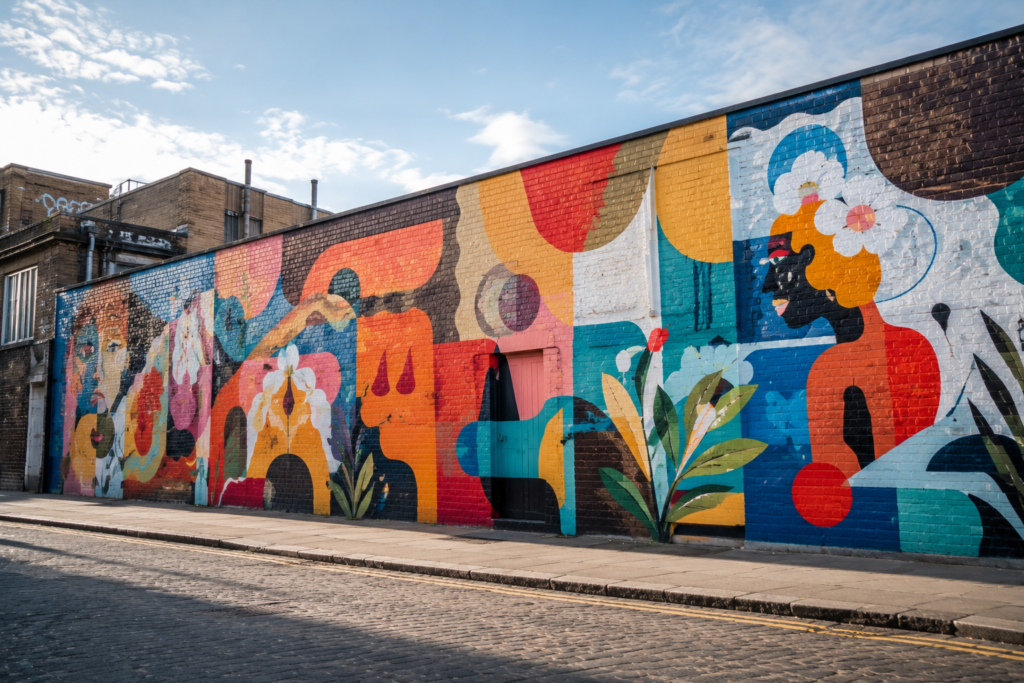
Shoreditch High Street Overground is one stop from Liverpool Street — under two minutes on the train — and deposits you into one of London’s most concentrated creative neighbourhoods. Boxpark, the original pop-up mall in repurposed shipping containers, is immediately outside the exit. Redchurch Street, heading east, is where east London’s best independent retail is concentrated: menswear, interiors, independent bakeries, and restaurants that have been drawing queues for years. The street art on Rivington Street and Great Eastern Street changes regularly and is worth a dedicated hour if you have not been recently.
10. Walk the Boundary Estate
Ten minutes’ walk north of Liverpool Street, the Boundary Estate is London’s oldest council housing estate — and one of its most beautiful. Built in the 1890s on the site of the notorious Old Nichol slum, it was designed around a central bandstand on Arnold Circus, with streets radiating outward in a pattern that is still clearly legible. The Arnold Circus bandstand was recently restored and hosts occasional free concerts. The estate is a genuinely moving piece of social and architectural history and is almost entirely overlooked by most visitors to the area.
Free and unhurried: Worth walking slowly — the estate’s circular design is best understood from the bandstand at the top
11. Try the Ten Bells
The Ten Bells pub on Commercial Street, directly opposite Christ Church Spitalfields, has been serving the area since the eighteenth century. Its Victorian tiled interior is extraordinary, and its history is genuinely dark — it is believed to be where two of Jack the Ripper’s victims were last seen alive. The current management has brought it back to life as a proper east London pub, serving good beer and decent food without leaning too heavily on the grim history. It fills up on evenings and weekends; arrive early if you want a seat near the windows looking out at the church.
12. See the Gherkin (and the Emerging Cluster Around It)
The 30 St Mary Axe tower — the Gherkin — is five minutes’ walk west of Liverpool Street into the City and remains one of the most architecturally satisfying buildings in London’s increasingly cluttered skyline. The surrounding Heron Tower and Leadenhall Building (the Cheesegrater) complete a cluster of genuinely ambitious twentieth and twenty-first century architecture that repays study. The area is best visited on a weekday when the City is alive; at weekends it has a ghost town quality that is interesting in its own way.
Where to Stay Near Liverpool Street
Liverpool Street sits on the boundary between the City and east London, which gives it an unusually good range of accommodation options at different price points.
- Andaz London Liverpool Street (5-star, directly above the station) — exceptional location, well-designed rooms, excellent bar
- citizenM London Shoreditch (design-led, excellent value, 10 min walk) — good option for design-conscious travellers
- Z Hotel Liverpool Street (budget-smart, very central) — small rooms but well-run and genuinely good value
- Novotel London Liverpool Street (mid-range, reliable, good breakfast) — solid choice for business or leisure
→ Compare rates and book via Booking.com for the best available prices
Book a Food Tour of the Area
The concentration of food history around Liverpool Street — Spitalfields, Brick Lane, the old Jewish East End — makes this one of London’s best areas for a guided food experience. Options worth booking:
- East End Food Tour via GetYourGuide: covers Brick Lane, Spitalfields Market, and the immigrant food history of the area — typically 3 hours, includes tastings
- Shoreditch Street Art and Food Walk via Viator: combines the mural trail with stops at the area’s best street food spots
- Jewish East End Walking Tour: covers the history of the Jewish community in Spitalfields and Whitechapel, including the remaining synagogues and former tailoring workshops
Practical Information
Getting to Liverpool Street: Central, Circle, Hammersmith & City, Metropolitan lines, plus the Elizabeth line. National Rail services from Liverpool Street to Cambridge, Norwich, and Stansted Airport.
Step-free access: Liverpool Street station has step-free access from street to platform on the Central line and Elizabeth line. Check TfL’s step-free guide for the most current information on all lines.
Zones: Liverpool Street is in Zone 1 for all lines.
Best time to visit Spitalfields Market: Weekday mornings are quietest; Thursday antiques market is a particular highlight. Avoid Sunday lunchtime if crowds bother you — the market can get very busy.
Keep Exploring London by Tube
Liverpool Street sits on four lines, which means you are never more than a few minutes from the next great area of the city.
- The Complete Central Line Guide — explore the full length of London’s busiest line
- The Complete Metropolitan Line Guide — from the City to the Chilterns
- King’s Cross Station Spotlight — the neighbourhood that reinvented itself
- What to Do Near Bethnal Green: East London’s Cultural Quarter by Tube
- London for First-Time Visitors: The Ultimate Tube-Based 3-Day Itinerary