The Complete Guide to London’s Tube Zones, Fares & Oyster Card in 2026
If you’ve never used the London Underground before, the zone map alone can feel like it’s trying to intimidate you. Coloured lines, numbered rings, an alphabet soup of ticket types — it looks more complicated than it actually is.
Here’s the truth: once you understand three things — zones, how to pay, and daily caps — you’ve got 95% of what you need to travel around London without overpaying or overthinking it. This guide covers all of it, in plain English, with nothing assumed.

How London’s Zone System Actually Works
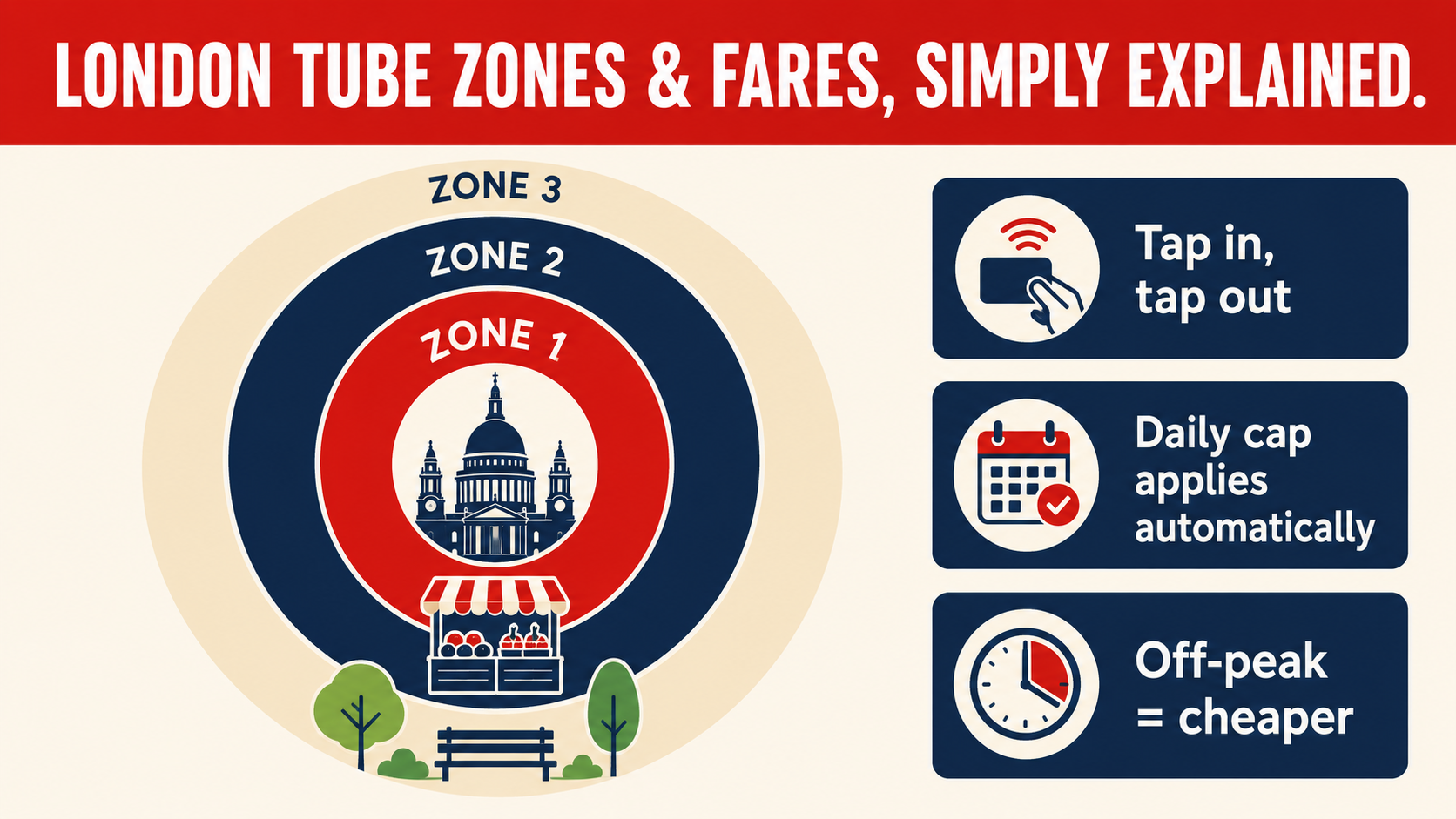
London’s Underground network is divided into nine concentric zones, radiating outward from Zone 1 in the centre (think: the West End, the City, Westminster, most of what visitors come to see) to Zone 9 on the far outer edges, which most tourists will never go near.
For a typical visit, you only need to think about Zones 1–3:
- Zone 1 — Central London. Covent Garden, Oxford Circus, Westminster, the City, South Bank. If you’re sightseeing, you’ll spend most of your time here.
- Zone 2 — The next ring out. Camden, Brixton, Greenwich, Shoreditch, Notting Hill. Still very much “London” in the visitor sense.
- Zone 3 and beyond — Where most Londoners actually live, and where a handful of specific attractions sit (Kew Gardens is Zone 3/4, for example). You’ll only pass through these if a specific destination pulls you there.
The rule that actually matters: the fare you pay depends on which zones you travel through, not how many stops you take. A one-stop journey that crosses from Zone 2 into Zone 1 can cost more than a five-stop journey that stays inside Zone 1 the whole way. This trips up a lot of first-time visitors who assume distance is what’s being charged.o Zone 1 can cost more than a five-stop journey that stays inside Zone 1 the whole way. This trips up a lot of first-time visitors who assume distance is what’s being charged.
Mastering Public Transport in London
What You’ll Actually Pay: 2026 Tube Fares by Zone
Here’s the exact pricing, so you can budget before you land. These are adult pay-as-you-go (PAYG) fares — identical whether you tap an Oyster card or a contactless bank card or phone — current as of March 2026’s fare update.
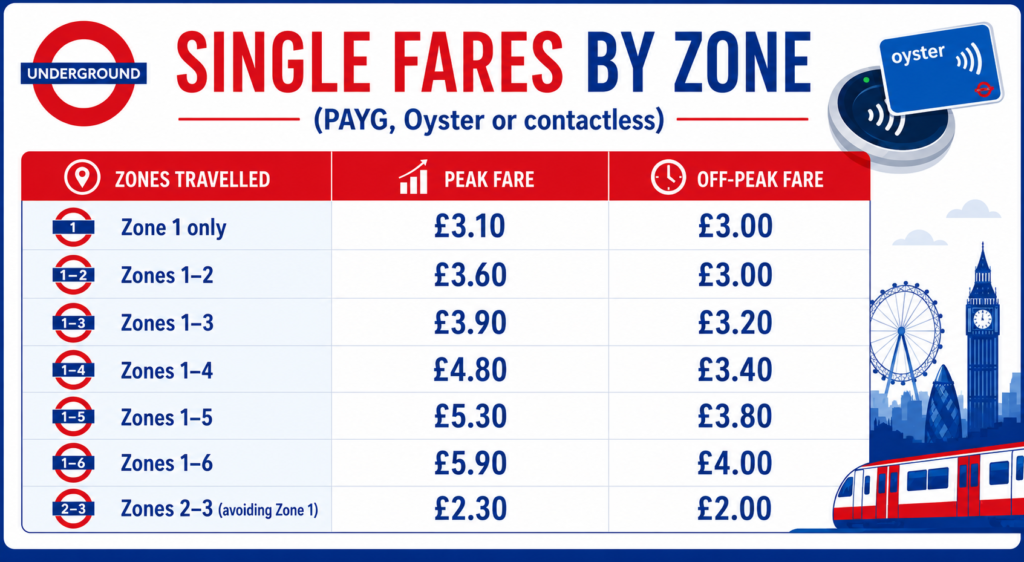
The gap between peak and off-peak is bigger the further you travel — on a Zone 1–4 journey, off-peak can save you well over a pound each way.
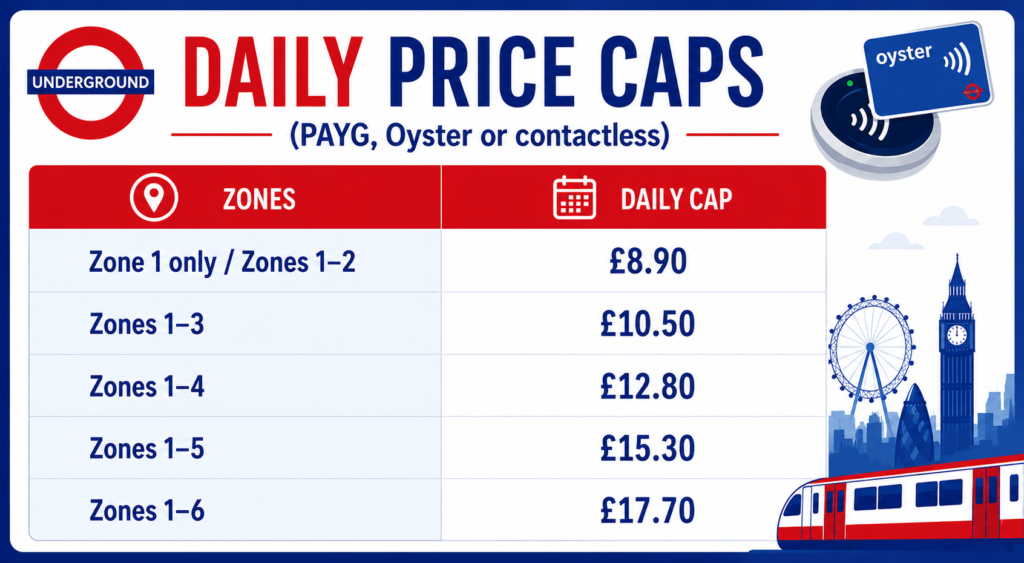
Daily caps apply regardless of whether your individual journeys were peak or off-peak — once you hit the cap for the zones you’ve travelled in, everything else that day is free. Weekly caps (Monday to Sunday) run at roughly five times the daily cap and work the same way, automatically.
Cash tickets: if you somehow end up buying a paper ticket rather than tapping in, it’s a flat £7.00 for any single journey across Zones 1–6 — always more expensive than PAYG, and something visitors should avoid entirely.
A note on accuracy: TfL reviews fares every March, and the numbers above reflect the 2026 update. Prices are correct at the time of writing, but for the exact fare on your specific route, always cross-check with TfL’s official Single Fare Finder at tfl.gov.uk before you travel.
How to Pay: Oyster Card vs Contactless
This is the question almost every visitor asks, and for most people in 2026, the answer is simple.
Use contactless (your bank card or phone) if:
- You have a contactless debit or credit card, or Apple Pay/Google Pay set up
- You’re only in London for a short trip
- You want one less thing to carry, top up, or lose
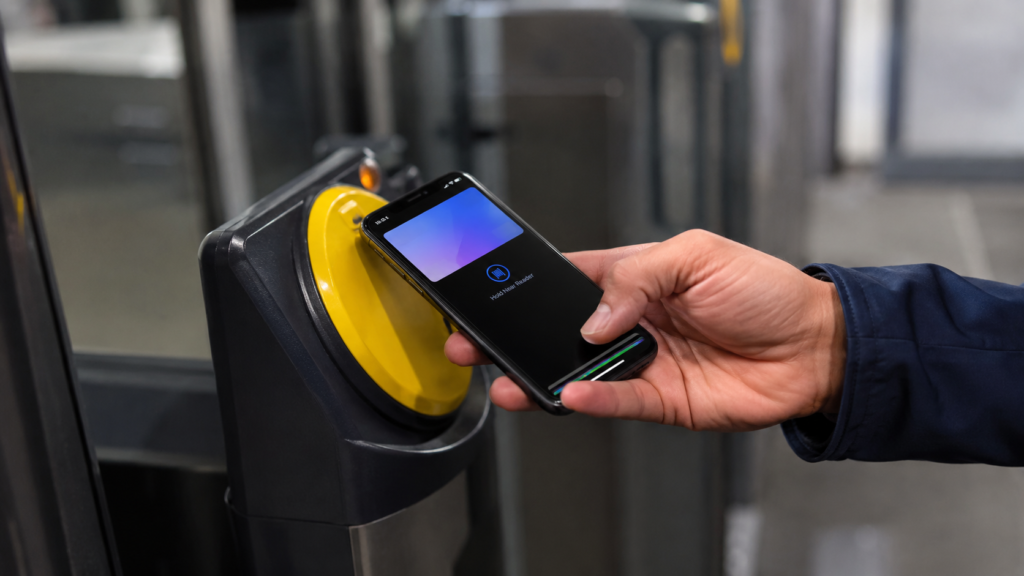
Contactless cards are charged the exact same fares as Oyster, capped the same way, and work by simply tapping in and out at the yellow readers — no queuing, no top-up, no faff. For the vast majority of visitors, this is now the easiest option, and it’s what TfL itself recommends for short stays.
Use an Oyster card if:
- Your bank charges foreign transaction fees on contactless payments abroad (check this before you land)
- You’d rather ring-fence your travel spending on a separate card
- You’re travelling with kids who need a Zip Oyster photocard (contactless doesn’t cover child discounts)
- You want a physical souvenir/backup card
An Oyster card costs £7 (refundable) and can be bought from any station or top-up point. Beyond that £7 deposit, there’s no real fare advantage over contactless — they’re priced identically.
The one mistake to avoid either way: always tap in and tap out, on both Oyster and contactless. Forgetting to tap out triggers a maximum fare charge, which can be considerably more than what you actually travelled. Make sure to use the same contactless payment everytime!
Daily and Weekly Fare Caps (This Is the Bit That Saves You Money)
Here’s the feature most visitors don’t know exists, and it’s the single most useful thing in this guide: you cannot be overcharged in a day.
Both Oyster and contactless automatically cap your spending at the level shown in the table above. Once you hit the daily cap for the zones you’ve travelled in, every further journey that day is free. You don’t need to do anything — no app, no registration — it just happens automatically as you tap in and out.
There’s a weekly cap too (roughly five times the daily figure), which activates automatically once your Monday–Sunday spending would exceed it. For a trip of four days or longer, this is often cheaper than a paper Travelcard, and it adjusts itself in real time rather than requiring you to buy tickets in advance.
Practical takeaway: don’t overthink individual fares. Just tap in and out normally for every journey, and the system will make sure you’re never paying more than the cap for that day or week.
Is a Travelcard Worth It for Tourists?
Paper and app-based Travelcards used to be the default advice for visitors. In 2026, they’re worth it in a narrower set of cases:
- Worth it: if you’re travelling in a group and want to buy one ticket per person in advance without dealing with cards or phones, or if you specifically want unlimited travel pre-purchased for peace of mind.
- Usually not worth it: if you already have a contactless card or phone, since the automatic daily/weekly cap achieves the same result with more flexibility and no risk of buying more zones than you actually use.
If you do want a Travelcard, a 7-Day Travelcard for Zones 1–2 covers almost everything a typical visitor does in central London, and can be loaded onto an Oyster card at any station.
Off-Peak vs Peak Travel — And How to Save
Peak fares apply roughly 6:30–9:30am and 4:00–7:00pm on weekdays, and they’re noticeably higher than off-peak fares for the same journey. Weekends and public holidays are off-peak all day.
For visitors, this matters more than it seems:
- If your itinerary is flexible, shifting a journey by 30–60 minutes outside peak windows can meaningfully reduce what you pay, especially if you’re making several trips a day.
- The daily cap itself is lower off-peak, so a day spent mostly outside rush hour costs less overall, not just per journey.
- Weekend sightseeing days are essentially “always off-peak,” so this isn’t something you usually need to think about on a Saturday.
Getting from Heathrow, and Other Fare Quirks to Know
A few extra things that catch visitors out:
- Airports carry a premium. The Piccadilly line and Elizabeth line both reach Heathrow, but journeys to/from the airport zones cost more than a standard Zone 1–3 fare — factor this into your first and last day.
- Contactless caps reset at 4:30am, not midnight. A very late night out technically still counts as “today” for capping purposes.
- National Rail overlaps sometimes have different pricing — a few Underground-looking journeys (particularly toward Zone 4+) are actually run by National Rail and can be priced slightly differently. Not something to worry about for a typical central London trip, but worth knowing if a fare looks unexpectedly high.
Step-Free Access: Planning an Accessible Journey
Not every station has step-free access from street to platform — roughly a third of the network does, concentrated more heavily on newer lines like the Elizabeth line and Jubilee line extension. If step-free access matters for your journey — whether for a wheelchair, a buggy, or heavy luggage — check the step-free tube guide and the TfL step-free map before finalising your route, since it can genuinely change which station or line makes the most sense.
The Short Version
- Zones determine price, not distance — Zones 1–3 cover almost everything visitors need.
- Contactless is the easiest option for most short-stay visitors; Oyster makes sense in a few specific cases. Make sure you use the sme payment method every time!
- Always tap in and tap out.
- Daily and weekly caps apply automatically — you don’t need to plan around them, just travel and let the system cap you.
- Travelcards are now a niche choice rather than the default.
- Off-peak travel (weekends, and weekdays outside 6:30–9:30am/4:00–7:00pm) is cheaper.
- Heathrow journeys carry a fare premium — budget for it on arrival and departure days.

Frequently Asked Questions
Do children travel free on the Tube? Under-11s travel free when accompanied by a fare-paying adult (up to four children per adult). Ages 11–15 need a Zip Oyster photocard for discounted travel.
Can I use my contactless card from a non-UK bank? Yes — contactless payment works with most international cards and mobile wallets. Check with your bank about foreign transaction fees before you travel, since this is the main reason some visitors choose Oyster instead.
How do I know when I’m changing zones on the train? You don’t need to — and that’s the point. There’s no announcement or signage on board telling you a train has crossed into a new zone; the system works it out automatically from where you tap in and where you tap out. The only “zone planning” worth doing happens before you travel: check the shaded zone bands on the Tube map to see roughly what a journey will cost, then just tap in and out as normal.
What happens if I forget to tap out? You’ll be charged a maximum fare for that journey (currently up to around £6.70 depending on zones). It’s refundable if you registered your Oyster card online and can explain the journey, but it’s simplest just to always tap out.